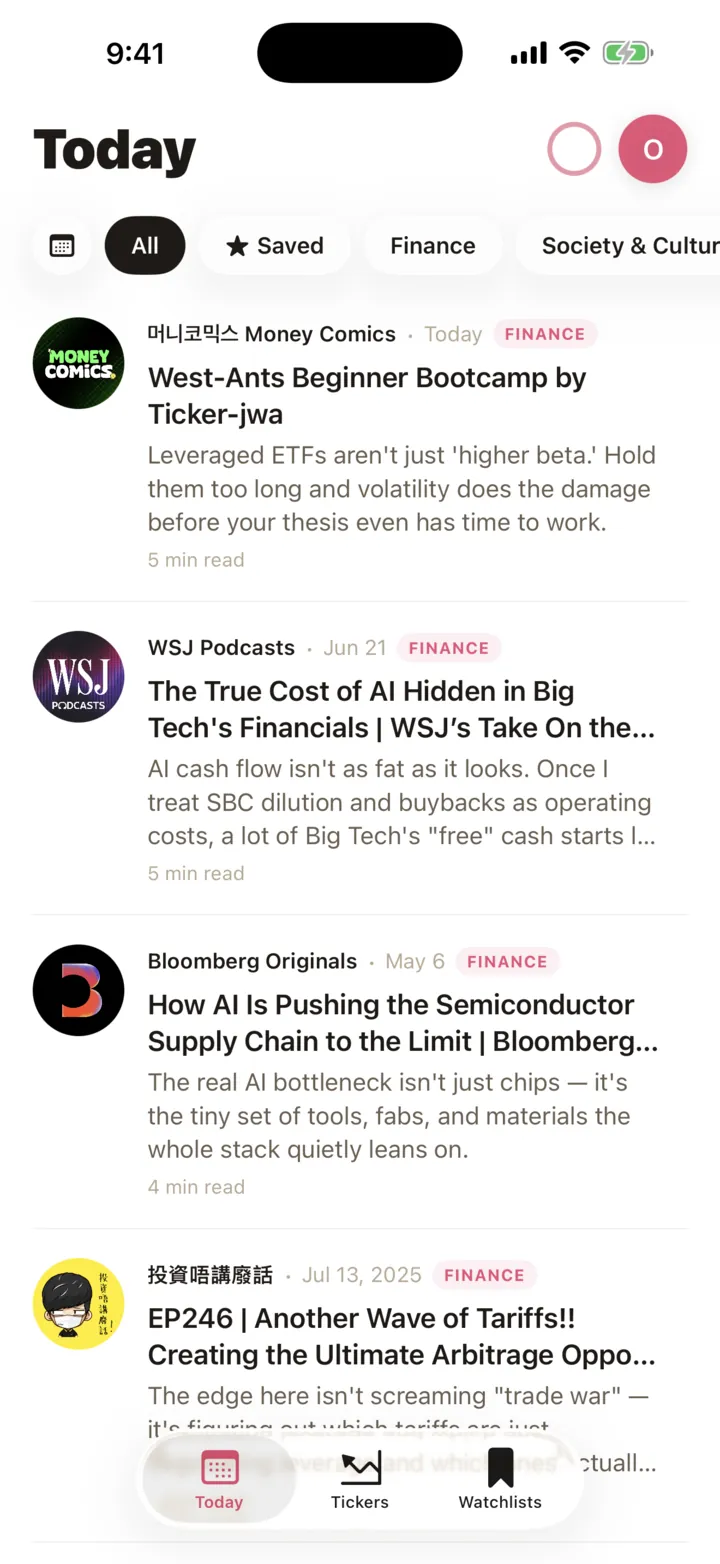
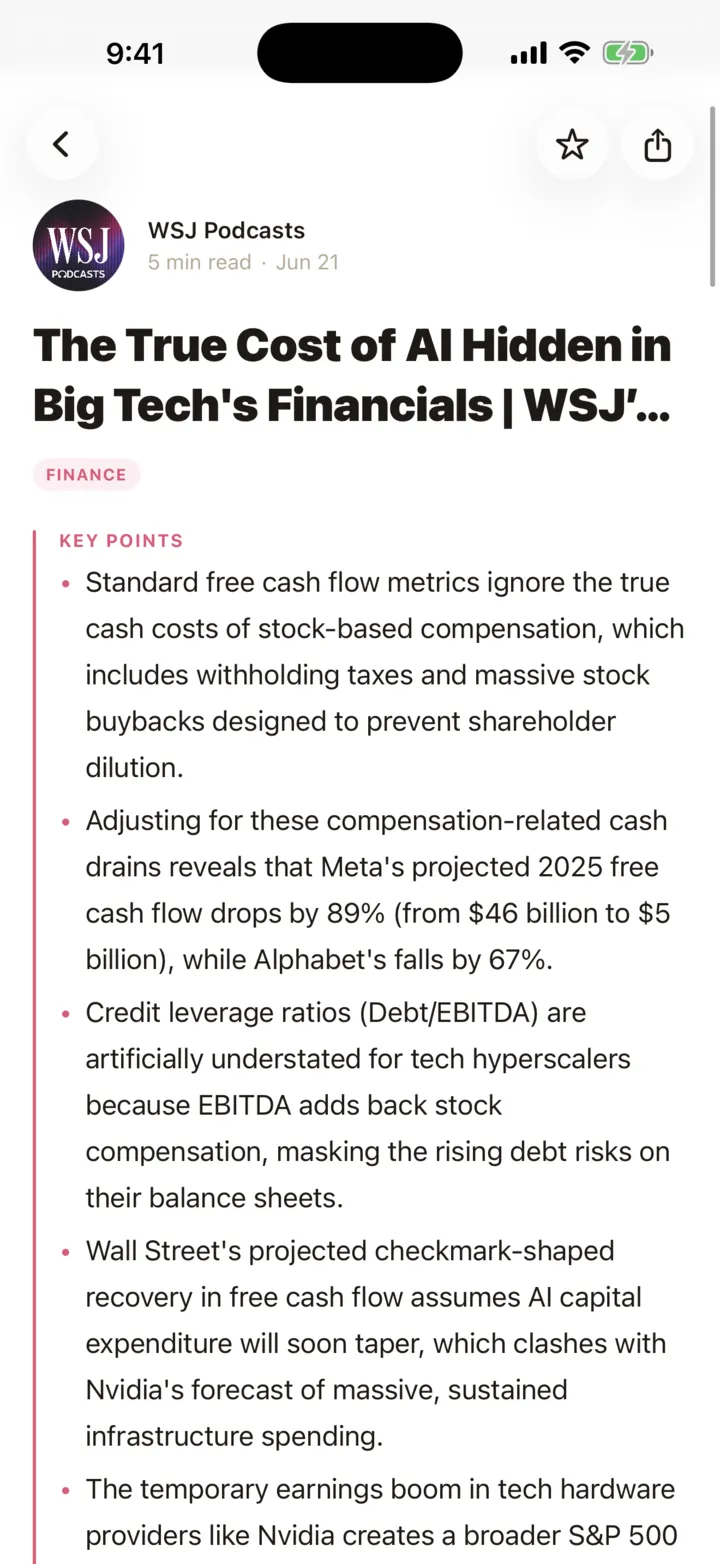
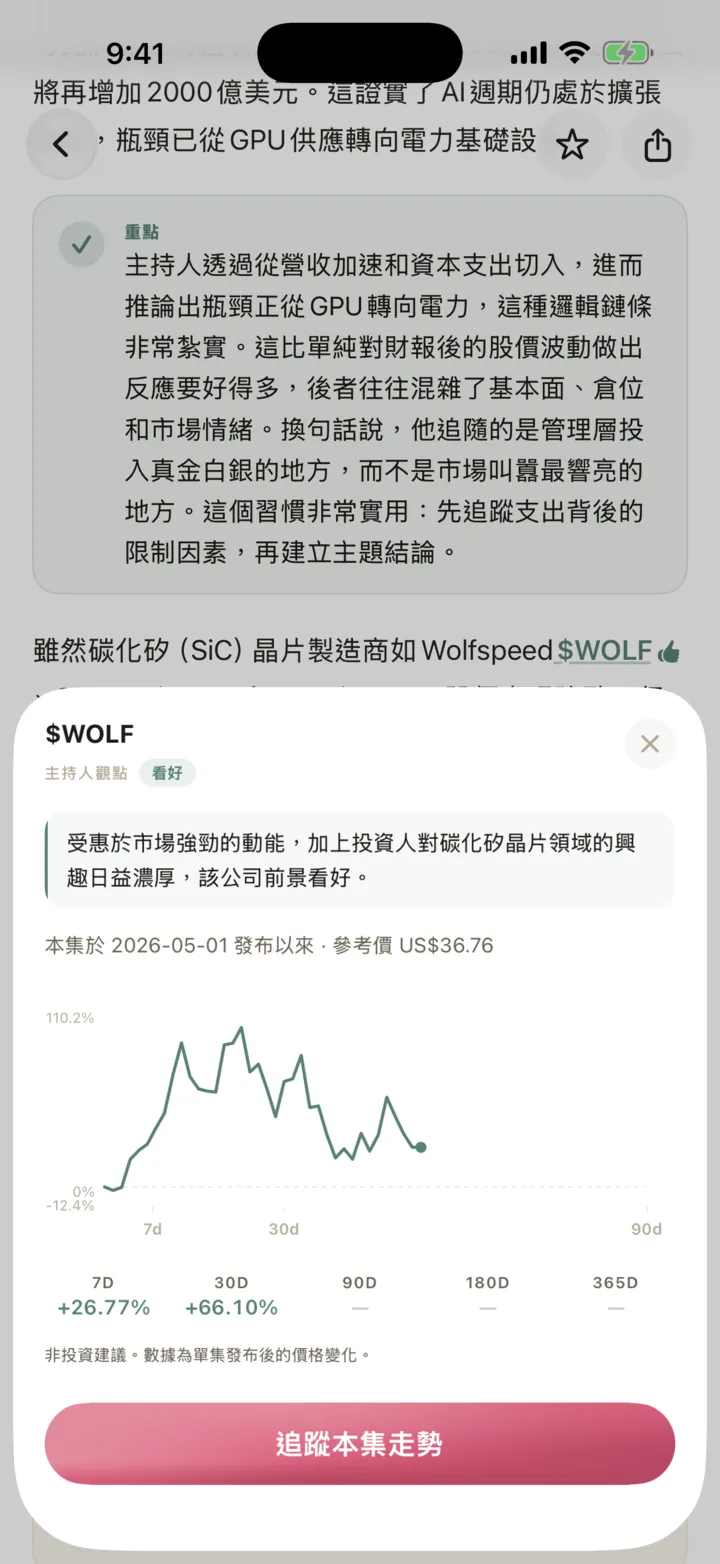
For finance podcast listeners

Notes. Knowledge. Tracking.

Every podcast becomes a complete brief, with arguments linked across shows and every stock or stance call tracked — all in your language.

NVDA's moat is CUDA, not the chip — and most coverage gets this backwards

The Tape5 min readMARKETS
TL;DR
  • NVDA's real moat is the CUDA software ecosystem — not raw H100/B100 compute

The host splits NVDA into two layers: on chips AMD has caught up, but the 15-year CUDA ecosystem lock-in is what holds the multiple. The most leveraged name is still $NVDA.

Most analysts ask: 'How many chip generations can NVDA stay ahead?' The right question: 'How many Fortune 500 production systems are already hardcoded to CUDA?' One sets the multiple. The other sets the runway.

Markers, not just summaries

Train your eye for sharp thinking.

Every brief flags reasoning quality inline. We can't fact-check — we don't have ground truth. What we can do is name the move when a host nails second-order thinking, and call out where they hand-waved past the obvious counter. Read enough briefs and you'll start spotting the gaps yourself.

The host noted that 3.2% GDP growth was half driven by inventory build — meaning next quarter's destocking will pull the headline back. Decomposing a headline into sustainable vs one-off is a move most coverage skips.

What earns a Strength: a named reasoning move — decomposition, exposed assumption, counter-example — not polished phrasing.

The host's core argument rests on 'the Fed never cuts with inflation above target' — but Greenspan's 1995 pre-emptive cuts under similar conditions are a precedent the host doesn't engage with. If that precedent holds, the argument doesn't.

What earns a Caveat: a counter-case or precedent the host's core conclusion depends on — not an incidental detail.

Stock tracking

Hold hosts accountable to their calls.

When a podcast host names a stock, we track it. Watch the call play out — 7, 30, 90 days after the episode aired.

The Tape
NASDAQ:NVDABullish
Since aired
7d
+0.0%
30d
+0.0%
90d
+0.0%

NVDA's data-center moat is widening, not narrowing

Illustrative only. Not investment advice.

Stance comes from how the host actually framed the call — not which company they happened to mention. We surface bearish, neutral, and bullish takes the same way.

Cross-episode anchors

Hear the other side, automatically.

Two podcasters can argue opposite sides of the same call without ever mentioning each other. Anchors connect them. Break your echo chamber without changing your feed.

Same anchor

The Fed should cut rates in September

The TapeMar 14

Why the Fed has to cut by September

Agrees
Real-rate compression is already priced in. Holding rates here past September means policy is tightening passively — they have to move.
Forward ReadApr 02

Why the September cut is a trap

Disagrees
Sticky services inflation isn't going away. Cutting in September with the labour market this tight gets them a second wave — they should hold.

Anchors are debatable propositions extracted from each episode. When two episodes disagree on the same anchor, we link them — even when the hosts never mention each other.

Stance over time

Watch a thesis evolve.

When a host's stance on the same anchor flips between episodes, we link them. Stay loyal to ideas, not personas.

Host's position changed
AI capex can sustain long-duration tech valuations
Jan 12
Why pullbacks are buying opportunities in AI hyperscalers
Latest episode
Capex growth is slowing — multiples need to reprice
Native, not translated

World-class shows, your language.

Briefs are written natively in your reading language — not machine-translated. See the source the host actually spoke, then how it lands for you.

Japanese podcast → English brief
東京マーケット
Original (Japanese)

植田総裁の今回の決定は、ハト派的な政策転換ではない。むしろ、コントロールが効かなくなったことを静かに認めたものだ。

Your brief

What the market is underestimating about the BoJ's pivot

Ueda's exit from YCC isn't a hawkish pivot it's a quiet admission control was already lost.

Briefs written specifically for your reading language — not just a translation.

Plans

Free to start. Upgrade when you outgrow it.

Every plan ships the same critical brief. Paid tiers add longer history, deeper stock tracking, and the cross-podcast debate layer.

All prices in US dollars (USD).

Most popular
Pro
$9.99/ month
Pro plan includes
  • 15 Watchlists
  • 600 Podcast minutes / month
  • Summaries kept forever
  • Stock tracking · 90 days
  • Host stance-change detection
Get started

Pick a plan after you sign up. No card required.

FAQ

Common questions

Is Podket free?
Yes — the Free plan covers a monthly quota of transcribed minutes and a 7-day brief history. Pro and Max unlock more minutes, longer history, and longer stock-tracking windows.
What sources does Podket support?
Any podcast with a public RSS feed — which means everything on Apple Podcasts, Spotify, and most independent podcast hosts — plus any YouTube channel that publishes long-form podcast or interview content. Paste the link on the Watchlists page; we do the rest. YouTube Shorts and livestreams are skipped.
How is Podket different from other AI summary tools?
Most AI summary tools hand you a bullet-point overview and stop there. Podket goes further: every brief flags sharp reasoning (✅) and unsupported leaps (⚠️) inline, surfaces cross-podcast debates when other hosts hold the opposite view, tracks how a host's stance has shifted across episodes, and links every stock mentioned to its actual price movement after the episode aired.
What languages can I read briefs in?
English and Traditional Chinese. Briefs are written natively in your chosen reading language — not machine-translated — so a Japanese or Chinese podcast still reads like it was written for you. Adding more languages over time.
How can I contact you?
Email hello@podket.app. We aim to respond within five business days. For takedown requests, use the dedicated Takedown page linked from the footer.

Free to start. Bring your podcast feed.

Add the shows you already follow. We'll transcribe each one — and read it critically — for you.

No credit card. Upgrade only when you outgrow Free.